
In Specified Skilled Worker (SSW) cases, employers often ask: “Can an administrative scrivener introduce foreign workers?” “Can a registered support organization dispatch workers?” or “Can you handle everything from the visa application through post-hire management?” The answer is that an administrative scrivener and a registered support organization have different legal roles. Recruitment and worker dispatch are separate activities that may require their own licenses and statutory conditions.
1. What an administrative scrivener can do
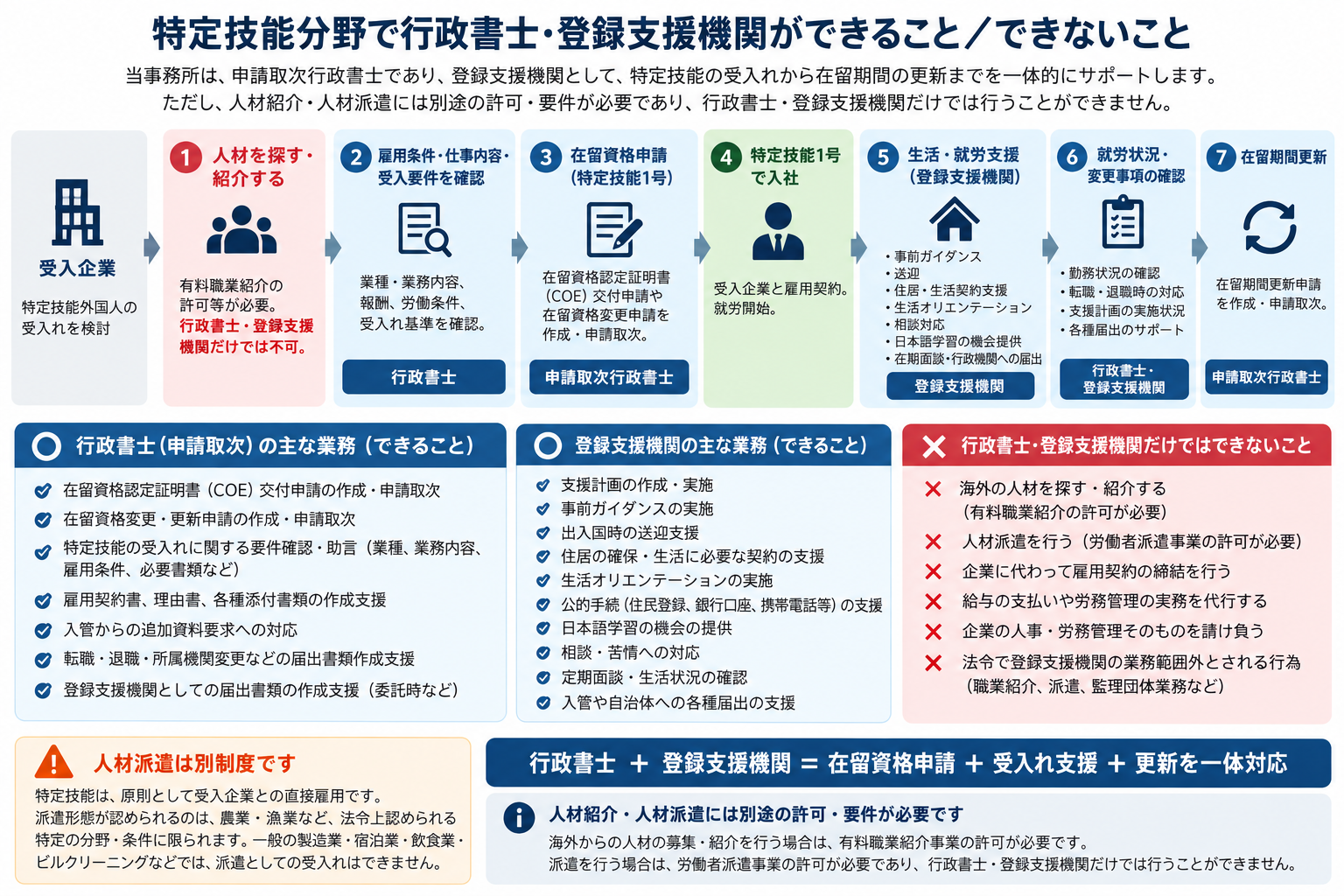
In SSW practice, the administrative scrivener’s core work is immigration procedure. This includes preparing and handling applications for a Certificate of Eligibility, change of status and extension of period of stay; reviewing SSW employment contracts and employment conditions; assisting with support plans; checking the accepting organization’s requirements and whether the proposed duties fall within the relevant SSW field; responding to requests for additional documents; and preparing explanatory statements and supporting documents. A qualified immigration application agent can also submit applications to Immigration on behalf of the applicant or company.
SSW cases must be reviewed as one package: the foreign national’s eligibility + the employer’s eligibility + actual job duties + pay and working conditions + the support structure. The real work is not merely filling in forms, but determining whether this particular foreign national can lawfully be employed by this particular company, in this particular role and under these particular conditions.
2. What a registered support organization can do
For SSW(i), the accepting organization must provide support so that the foreign worker can work and live in Japan stably. A registered support organization may be entrusted to provide that support.
- Pre-entry / pre-employment guidance
- Airport and other arrival/departure transportation where required
- Assistance with housing, bank accounts, mobile phones and utility contracts
- Daily-life orientation
- Guidance and accompaniment for public procedures
- Providing opportunities to study Japanese
- Consultation and complaint handling
- Opportunities for interaction with Japanese residents
- Job-change assistance where employment cannot continue for reasons attributable to the company
- Regular interviews and monitoring of living and working conditions
A registered support organization is not merely a document-preparation service. It is the entity actually responsible for ongoing support. The entrusted support function itself cannot simply be passed on wholesale to another company.
3. What can be handled on an integrated basis?
Where the same organization is both an administrative scrivener corporation and a registered support organization, it can continuously manage pre-filing review → SSW application → approval → onboarding → living/work support → regular interviews → renewal.
This makes it easier to identify discrepancies between the approved application and actual operations—for example, a salary being reduced after approval, a worker being moved to a different workplace, or the worker spending most of the time on duties outside the approved SSW field.
4. Registered support status does not itself authorize recruitment
Registration as a support organization and a license to operate a fee-charging employment placement business are different systems. If a business accepts job offers and job-seeker applications and intermediates the formation of employment relationships between companies and foreign workers, the activity must be conducted under the legally required employment-placement framework.
If the company has already selected the candidate and asks us to handle the SSW application and post-hire support, that is a typical administrative scrivener + registered support organization engagement. If, however, an operator recruits candidates overseas, matches them with employers and receives a placement fee when they are hired, employment-placement regulation must be considered.
5. Registered support status does not mean workers can be freely dispatched
As a rule, SSW employment is based on direct employment by the accepting organization. Dispatch arrangements are permitted only in limited fields and under specified conditions.
Calling an arrangement an “outsourcing agreement” does not resolve the issue. If Company B directly assigns the work, controls working hours and gives day-to-day instructions to a worker formally employed by Company A, the substance of the arrangement may be treated as worker dispatch. In practice, substance matters more than the title of the contract.
6. What an administrative scrivener or registered support organization cannot do merely by virtue of that status
- Operate fee-charging employment placement without the required authorization
- Dispatch workers without the required license and SSW conditions
- Use Company A as the nominal employer while the worker actually works under another company
- File an application describing non-eligible duties as eligible SSW duties
- Create a support plan but fail to provide the actual support
- Simply pass the entrusted support obligations to another company
7. In practice, first ask: “How did this worker reach this employer?”
Pattern A: The employer recruits directly and the foreign national applies directly. → The administrative scrivener handles the immigration application; the registered support organization provides support.
Pattern B: A licensed employment placement business introduces the foreign national to the employer. → The placement company handles matching; the administrative scrivener handles the application; the registered support organization handles support.
Pattern C: A registered support organization recruits candidates overseas, matches them with employers and charges a placement fee upon hiring. → “We are a registered support organization” is not enough; the employment-placement rules must also be examined.
8. SSW practice cannot be handled as “visa paperwork only”
Depending on the company, the process may need to be managed over a long period: recruitment → employment contract → immigration status → entry → living support → labor management → required notifications → renewal → resignation or job change. It is therefore important to understand the division of roles among administrative scriveners, registered support organizations, employment placement businesses and, where necessary, labor and social security attorneys.
Conclusion: the strength of combining immigration and support
Administrative scrivener = specialist in immigration and administrative procedures
Registered support organization = entity that provides statutory support to SSW(i) workers
When both functions are available, application → onboarding → support → change management → renewal can be managed continuously. Recruitment and dispatch, however, are separate regulated activities and may require separate licenses and SSW-specific conditions.
The goal is not to say “we can do everything.” The important thing is to know exactly what we can handle and where another license or professional is required. SSW practice should be viewed as one continuous process from recruitment and immigration status through actual employment, daily-life support and renewal.